Western NY Nocturnal Bird Migration Study
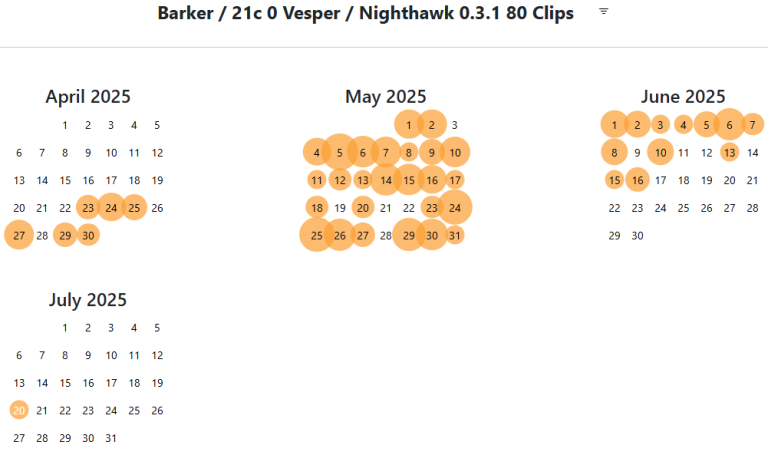
{If viewing on a smartphone, swipe left to center calendar)
From mid-April through into June, the archive contains bird call data from three stations (Barker, Newfane, & Station 5). Included are calls from the Dickcissel (DICK) detected by two different automatic detectors (Dick-r & Nighthawk-0.3.1), and the following species detected with Nighthawk-0.3.1: Grasshopper Sparrow (GRSP), Black-and White Warbler (BAWW), Canada Warbler (CAWA), Least Sandpiper (LESA) and Upland Sandpiper (UPSA). From mid-July on, the archive contains bird call data from five stations detected with Nighthawk-0.3.1 (including all six species noted above). As the season progresses, bird call data from the previous night will typically online by about 8am EDT each morning.
When first entering the archive, a calendar appears showing data for a single monitoring station. The station name is indicated at the beginning of page title and the name of the detector used to extract the calls is toward the end of page title. A date with an orange circle indicates that at least one call was detected that night (size of orange circle reflects the number of detections). Clicking on one of the orange circles in the calendar opens a album of the detections for that night at that station. The album shows a spectrogram for each detection - a visual representation of the sound energy with time on the horizontal axis, audio frequency on the vertical axis, and the loudness indicated by the level of darkness. To listen to a detection, move the mouse over the spectrogram and click the orange play button that appears in the upper left of the spectrogram.
All detections by the automatic call detectors in the archive are automatically classified to species. These detections are periodically proof checked by human inspection and incorrect identificatinos are detections reclassified as Noise (for mechanical sounds) or Other (for another species classified incorrectly).
Nighthawk 0.3.1 is the default detector data that appears when first opening the archive. One can use the 3-lined down arrow to the right of the Archive page title to access a menu for selecting data from the Dick-r Dickcissel detector (spring only). The 3-lined down arrow menu (see to the right below calendar) also enables a user to navigate to see data from five different stations and six species or Noise (false detections) and Other (detections from other species incorrectly identified) categories.
Additional Navigation Instructions
A clip album is organized into pages, with each page containing the spectrograms of the next batch of detections in the night. Navigation through the pages of a clip album is possible using the two small arrow buttons to the right of the album's title, or by typing the "Shift" and "<" or ">" characters on the keyboard. Navigation is also possible by clicking on the temporal display of detections below the call album title (darkening gray tones equal civil, nautical, and astronomical twilight respectively; black is night). The numbers labeling the plot are hours of the night, and the plot contains a vertical mark for each detection. The marks for the calls of the page being displayed are magenta, and the marks of other clips are orange. One can navigate among the pages of a detection album by clicking on the plot. As one moves the mouse over the plot, the marks for the calls of the page under the mouse turn green and clicking the mouse leads to that page.
